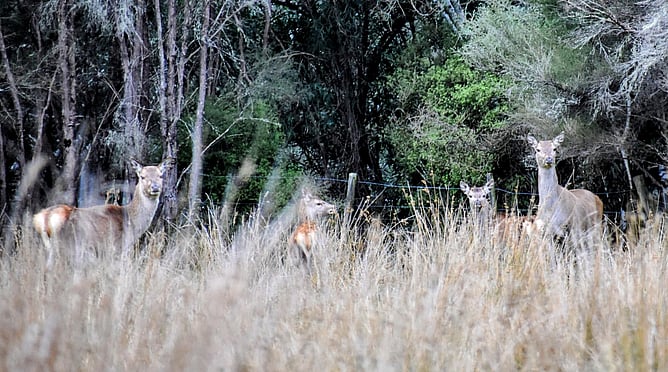
We are now several months into the pilots – funded by MPI looking at reducing the impacts of feral deer on productive land.
Since establishing the contract with MPI we ran a process to select a catchment group to work with and the decision was made to work with the Homewood Sustainability Action Group.
There have been several community meetings with great engagement from landowners, who know that this is a challenge they need to face together at a Catchment Scale.
Following a tender process we appointed contractors who are responsible for monitoring and control, and measuring impact on crops.
An initial survey was conducted with the catchment group to help assess the scale of the issue for each farm and why feral deer management is important to them. This will be followed up with a survey to be completed at the end of the pilot.
A thermal drone monitor was carried out across the catchment over two nights in August to establish baseline numbers. Alongside this 40 trail cameras were placed across the catchment.
A key outcome of this pilot is to understand the economic impact of feral deer on farms. Based on the initial baseline monitoring and spatial distribution in the catchment, three farms were selected for detailed farm systems analysis to be compiled throughout the pilot.
A community meeting was held early October and a Deer Control Plan presented for feedback. The plan sets out a 12 month deer control programme including 6 helicopter shoots across a 10 month window.
An initial cull by helicopter will happen early November. There will be a pre and post shoot thermal drone survey so we have a snapshot of deer numbers going into the shoot and immediately after. This will help us understand the changes occurring from the shoot, and also understand the detection probabilities of our methods.
The catchment pilot team meet monthly with MPI advisors to discuss the pilot and share knowledge with the other two catchment collectives – Hurunui & Rangitikei – who have funded pilots.