Despite a wild winter evening, more than 50 catchment leaders, landowners, partners and community members gathered in Masterton on 25 June for the Wairarapa Catchment Collective’s annual Catchment Groups Showcase and AGM.
The event provided an opportunity to reflect on another successful year of catchment action across the region - celebrating achievements, sharing lessons, and looking ahead to future opportunities.
Celebrating a year of collective impact
Project Lead Kirsty McCarthy and Chair Richard Johns presented highlights from the past year, showcasing the scale and impact of catchment group activity across Wairarapa.
Over the past 12 months, the Collective has supported 13 active catchment groups and worked alongside a further six developing groups. This included facilitating 25 planning sessions, delivering seven workshops, supporting 37 community events, and helping communities monitor 44 freshwater sites across the region.
Eight groups received coordinator grants, six are currently supported through the Collective’s fund-holding service, and more than $102,000 in external funding was secured to support catchment initiatives.
The Collective has also strengthened connections between schools and catchment groups through its partnership with Mountains to Sea Wellington, with 11 schools now actively engaged in projects and learning opportunities.
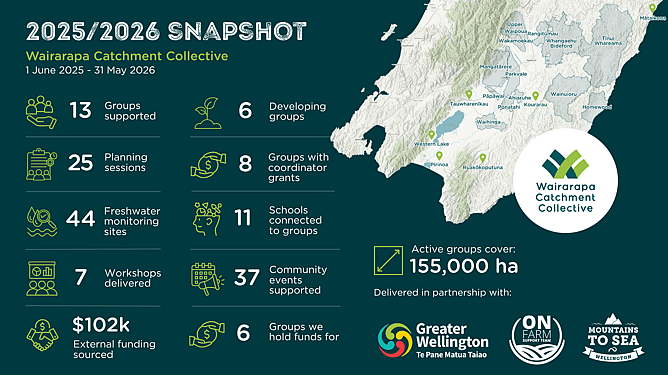
Partnership was a strong theme throughout the evening. Both Richard and Kirsty highlighted the value of close collaboration with Greater Wellington, MPI On Farm Support and Mountains to Sea Wellington.
“From a catchment group’s perspective, it doesn’t matter what logo is on someone’s shirt,” Richard said. “We’re all there representing the Collective and working together to support groups.”
Weekly coordination meetings, shared planning and collaborative delivery ensure groups can access the support, expertise and resources they need.
Richard acknowledged the work of the Collective committee, staff and partners, and thanked everyone involved in supporting catchment action across Wairarapa.
Kirsty reflected on the recent Sites of Significance hīkoi as a personal highlight, noting the powerful connection between people, place, shared history, and the collective commitment to improving catchment wellbeing.
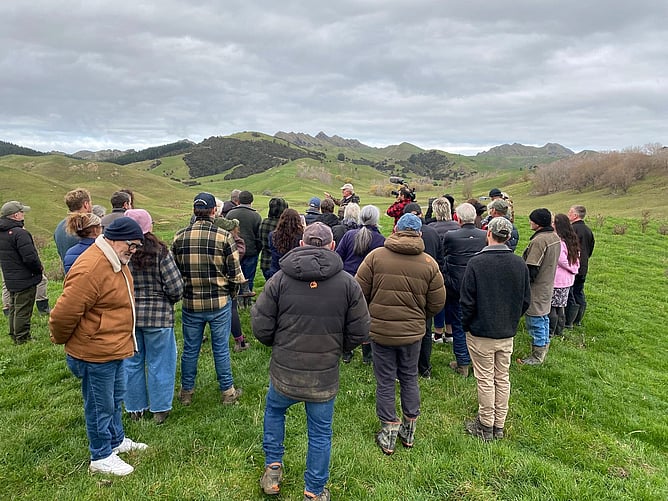
Wainuioru Hīkoi, Joseph Potangaroa
The evening also celebrated the Tīnui-Whareama Catchment Group’s recent showcase at the Ballance Farm Environment Awards and included a screening of their video.
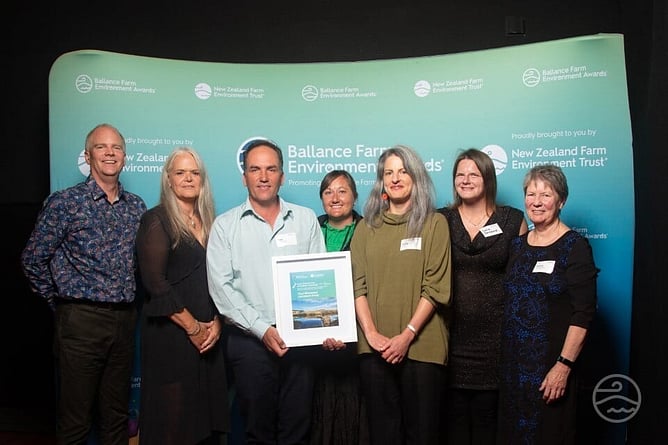
Tinui-Whareama Catchment Group (From left) Clint Radersma, Sue Malcolm, Sam Johnston, Nicky Brown, Holly Cole (Mountains to Sea), Claire Johnstone, Dianne Christensen (Photo: Ballance Farm Environment Awards)
Rachel Griffiths from Mountains to Sea Wellington, spoke about her experience working alongside catchment groups and schools, sharing her passion for freshwater critters and helping communities discover the diversity of life in their waterways.
Rachel highlighted findings from recent eDNA testing, including the detection of kākahi (freshwater mussels) and īnanga in the Wainuioru catchment. As īnanga provide an important transport stage for kākahi during their lifecycle, the presence of both species is an encouraging sign for the health and ecological connectivity of the catchment.
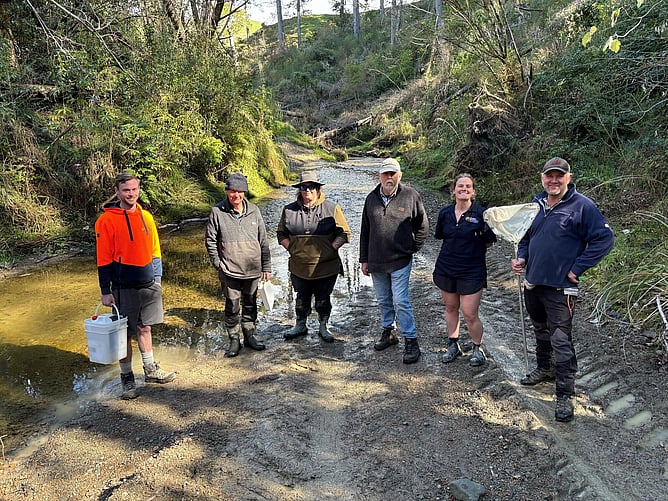
Monitoring in the Wainuioru catchment with the catchment group, Mountains to Sea Wellington and Greater Wellington crew
MPI Feral Deer Management Pilot Project underway
Partnership Lead John Hart provided an update on the MPI Feral Deer Management Pilot Project - one of only three pilot projects funded nationally.
The Wairarapa Catchment Collective was invited by MPI to design and deliver the pilot, which will explore how coordinated feral deer management influences farm productivity, environmental outcomes, and long-term management approaches.
Progress to date includes establishing a project steering committee, developing the framework, and selecting the Homewood Sustainability Action Group as the pilot catchment following an expression of interest process.
The project is now moving into baseline monitoring and implementation, with ongoing co-design alongside the catchment group and project partners.
Building resilient rural communities
A session on rural wellbeing and resilience, presented by Sarah Donaldson (Rural Support Trust) and Mel Arcus (WREMO), highlighted the vital role of connected communities during times of adversity.
Drawing on recent extreme weather events, both speakers emphasised that strong social connections help communities respond to and recover from emergencies.
Sarah introduced the Five Ways to Wellbeing - connect, give, take notice, keep learning and be active - and shared how community initiatives such as Surfing for Farmers, sports events, planting days and catchment showcases can support wellbeing and resilience by including the Five Ways to Wellbeing.
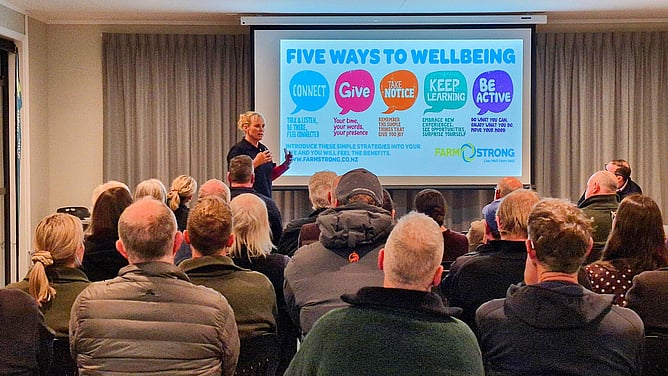
Mel shared practical examples of emergency preparedness already underway, including community resource databases, communication networks, VHF radio systems and neighbourhood support initiatives.
The session reinforced that catchment groups deliver far more than environmental outcomes - they also help build stronger, more connected and resilient rural communities.
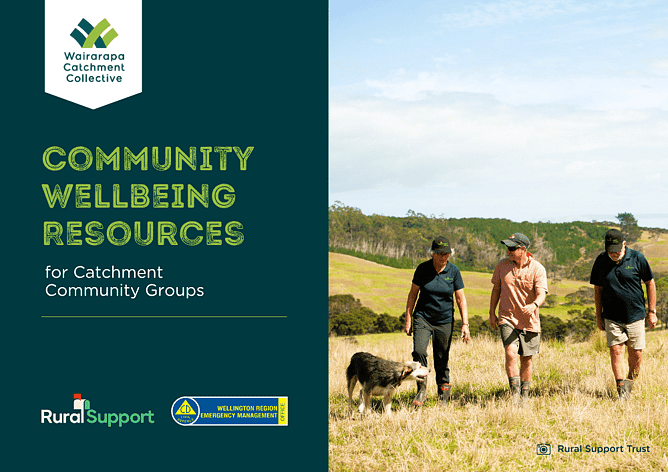
Attendees also received copies of the Community Wellbeing Resources for Catchment Groups guide, which brings together Wairarapa-based support services, wellbeing tools, emergency preparedness resources and local organisations. Designed for catchment groups, neighbourhood networks and rural communities, it aims to strengthen local connections and improve readiness before, during and after adverse events.
Upper Waipoua Kaitiaki Catchment Group showcase
The evening concluded with a showcase from the Upper Waipoua Kaitiaki Catchment Group, featuring a Q&A session with Jason Christensen and Jazz O’Connor.
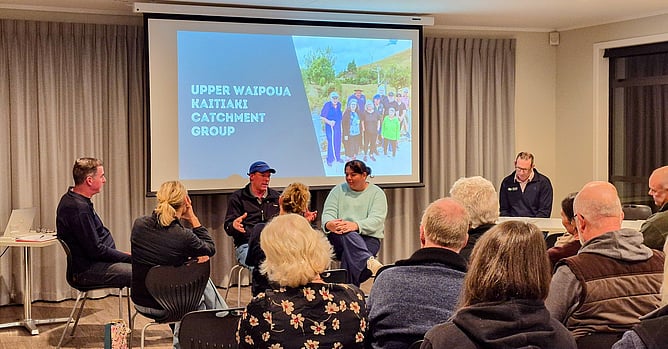
The group reflected on a busy year, including expanding to include the Mikimiki Valley - bringing together a diverse mix of farming and lifestyle communities with a shared commitment to caring for their catchment.
Highlights included annual stream walks and citizen science activities, Sites of Significance hīkoi exploring local history, and pest weed workshops delivered with Trevor Thompson.
They also spoke about the value of Greater Wellington’s water quality reporting in helping both group members and Opaki School students better understand the health of their waterways.
The showcase provided a fitting conclusion to an evening celebrating the power of communities working together to improve the health and wellbeing of their catchments - now and for future generations.