The Wairarapa Catchment Collective recently hosted a discussion on pest animal management at a landscape scale. Over 50 participants attended, including community and catchment group members, landowners, agency representatives, and pest control specialists, to explore regional programmes, coordinated control efforts, on-farm impacts, and practical approaches for managing pest animals.
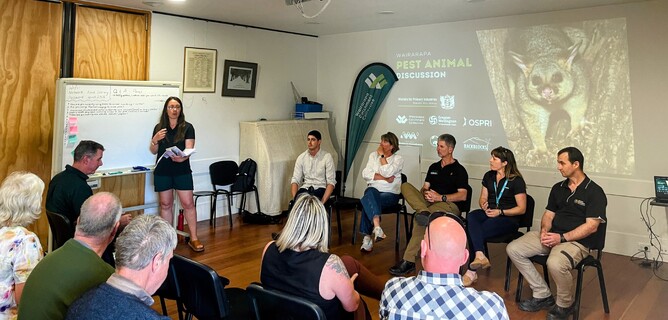
Building coordination and capability
Kirsty McCarthy, Wairarapa Catchment Collective Project Lead
Kirsty highlighted that pest animals are a major concern for catchment groups, who have called for coordinated management. Pest control is a key focus of catchment groups action plans that link to broader environmental, economic, and social outcomes.
In response, the Collective launched the Pest Animals Project led by John Bissell, supporting six groups across roughly 11,000 hectares with around 320 traps. More than 120 community members have participated in workshops and training, and the project has secured over $46,000 in funding to build capability and foster learning.
As an umbrella organisation, the Collective links catchment groups with landowners and key agencies, making it easier to access resources and coordinate projects. Kirsty highlighted that collaboration with Greater Wellington fosters shared learning and joint action across the pest animals project. This collaborative approach enables smarter, more efficient work - for example, the Homewood pest project, where coordinated planning, funding, and contractors are creating a cost-effective predator control network.
On-farm impacts and costs
John Bissell, Backblocks Environmental Management Ltd Director
John spoke about the economic and environmental risks pest animals pose to farms. Pests compete for feed, increase disease and parasite risk, cause lamb predation or mismothering and damage forest remnants and native vegetation.
Using cost-per-stock-unit data, John illustrated the scale of annual losses caused by possums, deer, pigs, goats and other species. A Wainuioru case study showed that targeted possum control delivered $5,500 in production gains, highlighting that the cost of inaction exceeds the cost of control.
John stressed that for planting and production to be effective, a portion of budget needs to be allocated to pest management.
Learn more about Backblocks: www.bbem.co.nz
Strategic regional predator control
Glen Falconer, Greater Wellington Pest Animals Team Leader
Glen provided an overview of the Regional Predator Control Programme (RPCP).
Greater Wellington manages an 800,000-hectare region, controlling pest animals across 200,000 hectares (approximately 60,000 hectares per year) with a budget of $1.6 million - which breaks down to $26.60 per hectare per year.
Challenges include increasing predator numbers, predators using buffers and corridors to move around landscape, limited budgets, higher densities of possums, rising economic risks and habitat loss.
Greater Wellington has shifted to a multi-criteria prioritisation system that considers possum density, biodiversity value, productive land, and community and mana whenua input to target high-value areas while balancing economic outcomes. Strategic focus in the Wairarapa for the next three years will be the Western Ruamāhanga Valley, Awhea, and north-east Wairarapa.
Glen encouraged landowners to contribute to work programmes by engaging with submissions on regional pest management and long-term planning.
Collaboration is central to the programme, with Greater Wellington seeking to coordinate efforts with community groups, Department of Conservation, Predator Free initiatives, OSPRI, and other projects to ensure control efforts are aligned across landscapes and pest types.
Landowners are encouraged to contact Greater Wellington directly or via their catchment group and the Collective to access advice and resources through the council’s website:
Learn more:
Pest management operations
Pest Hub
TB management
Zoe Matthews, OSPRI Supervisor
Zoe spoke about the organisation’s role in bovine TB and other animal health programmes, including NAIT, TBFree, and MBFree. Possums remain the primary wildlife vector for TB.
As of November 2025, there were just 15 infected herds nationwide. Most of the Wairarapa is classified as a Vector Free Area, with remaining Vector Risk Areas under surveillance, particularly in the Tararua and Remutaka ranges, which are nearing the completion of final aerial operations.
Zoe emphasised that while OSPRI focuses on disease eradication, ongoing pest management by communities is essential. Wairarapa aims to achieve Vector Free status by 2040, and landowners are encouraged to build on OSPRI’s knockdown work to maintain gains.
Learn more:
OSPRI pest control in the Wellington region
Predator Free communities
Esther Dijkstra, Wairarapa Pūkaha to Kawakawa Operations Manager
Esther discussed the importance of urban and peri-urban pest management, highlighting the role of Predator Free communities and backyard trapping.
Esther noted that WaiP2K’s mission - creating “connected communities where land, water, and people flourish”, relies on effective pest control as a core building block.
A region-wide pest animal stocktake commissioned by WaiP2K in 2022 found strong community-led momentum but also fragmentation and under-reporting, reinforcing the need for better coordination.
Predator Free initiatives are now active in all five Wairarapa towns, driven by volunteers, including support from WaiP2K and local Menzshed groups.
Esther emphasised that biodiversity recovery requires joined-up pest control efforts from urban centres through to rural landscapes.
Looking ahead, priorities include expanding peri-urban participation, offering further training, and strengthening partnerships to scale up the impact of control work.
Learn more:
Predator Free Wairarapa
Ungulate control - deer recovery
Jordan Munn, Trap and Trigger Director
Jordan presented on ungulate management, focusing on feral deer. Unmanaged deer remove up to one-third of forest understory, degrade ecosystems, and increasingly appear on farmland, backyards, and even urban areas.
Control methods include hunters with dogs, aerial shooting, thermal drone-assisted hunting, night shooting, trapping, and the Wild Animal Recovery Operation (WARO). Recreational hunting alone is insufficient; effective control requires targeted removal of hinds.
Jordan also outlined the economics of WARO, noting that operations can become cost-neutral or profitable for landowners at around 35 kg carcass weight. Regulatory challenges including poison buffer zones and landowner declarations remain significant.
Learn more:
Trap and Trigger
Collaboration is essential
The discussion highlighted that the scale and cost of pest control in the Wairarapa are too great for any single person, landowner, or agency to manage alone.
Coordinated action across catchment groups, landowners, and agencies is essential. Without effective pest control, planting, reforestation, and biodiversity initiatives cannot succeed, and the economic cost of inaction continues to rise.
Through collaboration, training, strategic planning, and community engagement, the Wairarapa Catchment Collective and its partners are working to address these challenges at a landscape scale, protecting farms, forests, and native ecosystems for the future.
Take action
Want to take action in your catchment? Join your local catchment group or start one in your area. Get in touch with the Collective for support or access Greater Wellington website for details on the Regional Predator Control Programme, current operations and advice for pest control.